APPLICATION OF THE ACT
The act covers only specified public examinations conducted by Central authorities mentioned under the Schedule including examinations conducted by:
MEANING OF “UNFAIR MEANS”
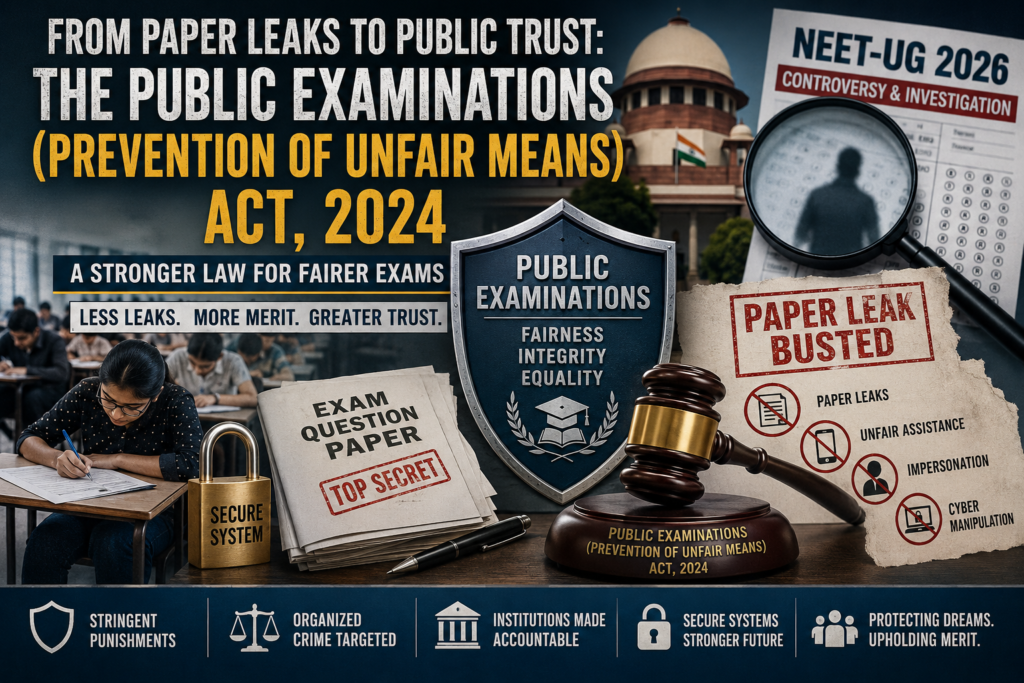
The Act gives an expansive definition of “unfair means” under Section 3. It criminalises virtually every organised method through which examination integrity may be compromised.
Unfair Means includes:
Any unauthorised access to question papers before commencement of examination.
Sharing confidential answer keys before official publication.
Providing assistance to candidates by giving answers during examination through electronic communication, external assistance or by using hidden devices.
Tampering with computer systems by hacking examination servers, altering databases, manipulating digital examination systems or by unauthorised access to computer networks.
Manipulation of merit lists by altering marks, rankings, selection lists or evaluation records.
The Central Government may authorise investigating officers not below the rank of Deputy Superintendent of Police or Assistant Commissioner of Police to investigate offences under the Act. The offences under the Act are Cognizable, Non-bailable and Non-compoundable. This means police can investigate without prior court permission, bail is not automatic, and parties cannot privately settle such offences.
The legislation prescribes stringent punishments.
If an institution is involved in committing an organised crime, its property shall be subjected to attachment and forfeiture and proportionate cost of examination shall also be recovered from it.
THE ANTI-PAPER LEAK ACT, 2026
Formally known as the Public Examinations (Prevention of Unfair Means) Amendment Act, 2026 is a legislation introduced in India’s Lok Sabha on July 2026.
key Amendments includes-